Executive Summary
Newly passed housing legislation is anticipated to:
- Avoid major market disruptions that prior versions of the legislation may have caused.
- Accelerate the trend toward BTR strategies (the construction of purpose-built single-family rental homes) and away from scattered SFR (the conversion of owner-occupied homes to rental properties).
- Have a limited impact on the overall supply landscape for market-rate housing rentals.
Introduction and Overview
After months of deliberation and major revisions along the way, the 21st Century ROAD to Housing Act (the “Act”) became law on July 11, 2026.
The final law contains several provisions that impact U.S. rental housing. This paper focuses on single-family rental homes (“SFR”) and build-to-rent communities (“BTR”), a subset of SFR that consists of homes that are designed and built specifically as rentals. It also discusses several related housing sectors that may influence the competitive landscape for SFR, including traditional apartments, manufactured home communities, and affordable housing.
In some cases, the absence of certain provisions from the final version of the Act is at least as important as what was included.
SFR ACQUISITION LIMIT. The Act generally prohibits for-profit institutions from acquiring more than 350 single-family homes, subject to a number of exceptions.
MAJOR EXCEPTIONS. Certain homes are generally exempt from the purchase restriction, and may continue to be held by, and transferred among, institutional owners without counting toward the 350-home limit:
– Grandfathered Homes. Rental homes already held by institutional owners.
– Build-to-Rent. Homes that are purpose-built as rental properties.
Some other exemptions are noted later in this paper.
DIVESTITURE REQUIREMENT (absent). The final law does not require owners to sell rental homes after a set period. A prior Senate version would have required institutional owners to sell certain newly-acquired rental homes within seven years, including BTR assets. NAHB and Urban Institute estimated that the earlier Senate version of the legislation could have “cut single-family production by 40,000 to 72,000 units annually”.1
Investment Implications
Townsend recently published its latest Real Estate View of the World, affirming positive overall outlooks for several housing strategies in the United States. The discussion below focuses specifically on the Act’s impact.
Impact on Build-to-Rent
Build-to-rent strategies consist of single-family homes that are designed and built specifically to function as rental properties, often as part of a contiguous community with common amenities. Our view of the sector is generally positive:
Advantages– Strong demographic demand for affordable detached homes – Operational efficiencies from contiguous communities and semi-homogenous units – Less political risk (adding new housing stock) – Improved tenant experience from amenities, professional management, and home design |
Drawbacks– New construction is often located far from employment centers – Longer-term demographic softness |
In our judgment, BTR is a beneficiary of the Act in two primary ways.
- – Capital Flows. The Act is anticipated to accelerate the shift of capital away from traditional scattered-site strategies (converting owner-occupied homes to rental properties). Current owners of BTR and grandfathered scattered-site SFR should benefit from redirected capital. The outlook is less clear for new entrants, who may face increased supply and increased competition for available sites.
- – Improved Regulatory Clarity. Finalization of the Act reduces political and regulatory risk for BTR. Prior versions would have ensnared BTR in significant restrictions, including the divestiture requirement discussed above. Investors have more certainty now that the Act has been finalized without those provisions. Notably, although the Act has been finalized, Treasury may issue additional rules.
We anticipate the impact on supply to be more nuanced and market-specific. As discussed later in this paper, BTR properties may be vulnerable to new supply from development as (i) capital shifts away from SSFR and toward BTR construction and (ii) the Act lowers barriers to development across BTR and other housing sectors, some of which compete at the margin with BTR for tenants.
We have recently affirmed a moderately positive view of the sector, and intend to continue actively exploring opportunities in the space with new and existing partners.
Impact on Grandfathered SFR
Scattered-site single-family-rental properties (“Scattered SFR” or “SSFR”), unlike BTR, generally consist of homes that were converted from owner-occupied properties into rentals.
Existing, grandfathered portfolios of Scattered SFR will likely benefit from reduced new supply of rental homes that are located near employment centers. While BTR and other strategies can add new supply to the broader market, the additions tend to occur further from city centers due to land availability. As a result, the stock of infill rental homes will be limited as Scattered SFR assets become more difficult to acquire at scale. We anticipate these homes to be attractive to certain renters and to institutional capital, creating scarcity value for existing owners.
Like BTR, grandfathered SSFR benefits from decreased political and regulatory risk.
Impact on Newly-Assembled SSFR
The Act is anticipated to significantly limit the assembly of new Scattered SFR portfolios, making the sector difficult for institutional investors to access. A 350-unit portfolio does not provide sufficient critical mass (diversification, liquidity, economies of scale) for some institutional capital. And the exit options for newly-assembled portfolios will be limited.
Exceptions do exist. Two of the most significant exceptions are for “Renovate to Rent” strategies (acquiring properties with significant deficiencies and undertaking a substantial renovation) and “Homeownership Programs” (providing tenants with pathways to purchase through first-look rights and/or financial assistance). But the overall impact on the sector is anticipated to be significant and negative. Limited opportunities may exist for investors who can navigate the new regulatory landscape and use the Act’s exceptions to assemble infill portfolios and benefit from reduced new supply.
Traditional Apartments
The impact on market-rate apartments is anticipated to be mixed.
The Act expands loan availability for apartment development, which should increase supply at the margin – particularly in suburban and exurban locations with available land and relatively low development constraints. These are some of the same areas where BTR development is likely to occur. However, because apartments and BTR typically compete for different types of renter households, the impact of overlapping new supply should generally be limited.
Impact on Manufactured Housing Communities
Like apartments, manufactured housing benefits under the Act from expanded loan availability. The sector also benefits from additional design flexibility, particularly the removal of a steel chassis building requirement. This lowers construction costs and will likely increase supply over time. In some ways, manufactured housing communities overlap more closely with BTR, offering an affordable detached housing option. In spite of the headwinds caused by new and overlapping supply, our overall view remains positive for both BTR and manufactured housing, driven by a broader housing shortage, the attractiveness of these sectors to tenants, and some natural supply constraints.
Overall, we anticipate the Act’s provisions related to manufactured housing to provide a small boost to an already well-positioned sector.
Impact on Affordable Housing
While the focus of this paper is on market-rate rentals and SFR in particular, the Act’s support for affordable housing is worth noting. Among other provisions, it broadens affordable-housing programs, expands tools for preserving rental-assisted properties, and supports preservation of rural assisted housing. These changes may improve the feasibility, financing and preservation of affordable housing projects, although the Act provides no new appropriations and the ultimate impact will depend on implementation and available funding.
Impact Summary: BTR and SFR
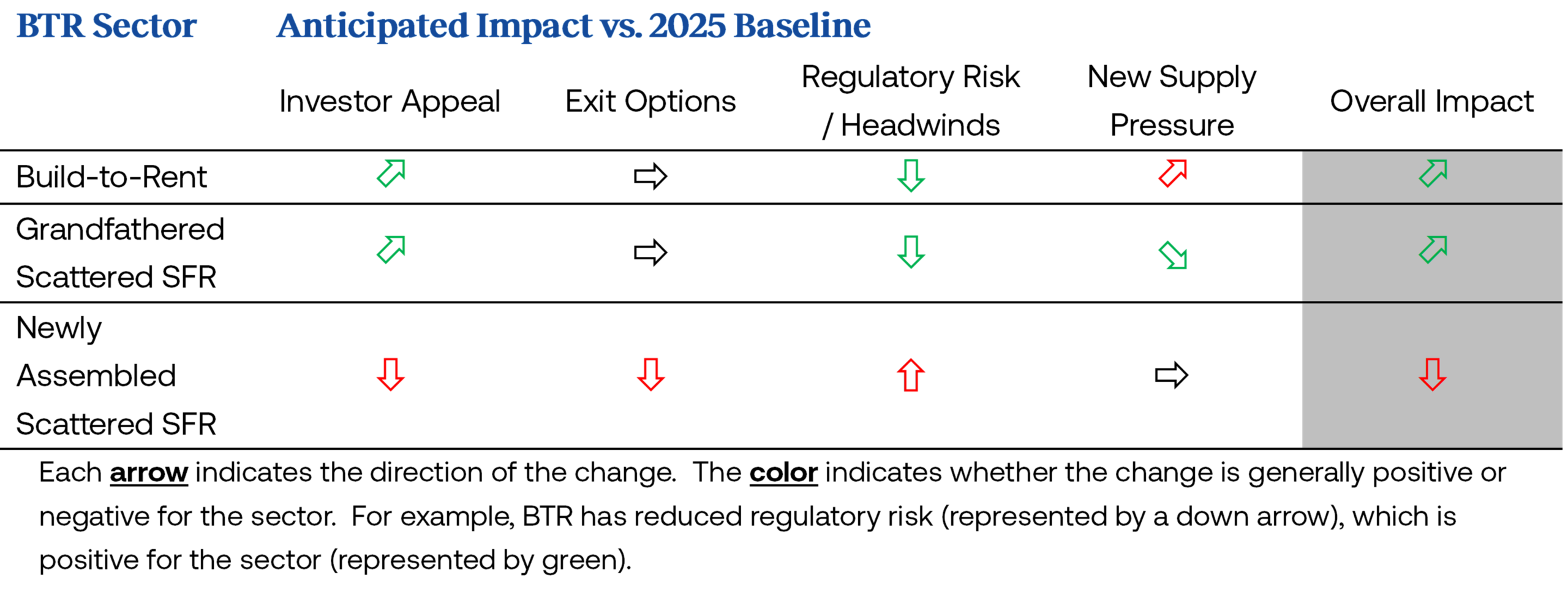
The table below summarizes our view of the Act’s likely impact on SFR sectors vs. a 2025 baseline (i.e., before a significant legislative push began in January 2026). The overall impact on each sector is summarized in the last column.
Limited Impact on Overall Supply
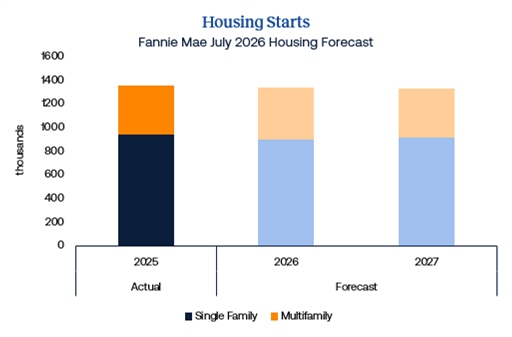
Superficially, the Act appears to dampen new supply of single-family rental homes by limiting the number of homes that can be converted by institutional investors from owner-occupied houses into rentals. However, several factors suggest that the overall impact on supply will be modest and that the direction of the change is not certain.
The Act is more likely to alter the type of new rental property that is created rather than the overall amount that is created – shifting the creation of new supply from infill locations to suburban and exurban locations.
Housing Units Remain in Place
Limiting institutional assembly of new SSFR portfolios doesn’t cause the homes to disappear. It simply means that they can’t be acquired by certain owners without an exemption. If existing homes are instead acquired by small landlords, they will remain part of the rental stock. If they remain owner-occupied, they will reduce the tenant base (and potential aggregate demand) for rental homes. The market can absorb significant changes in the composition of the housing stock as small, incremental adjustments by millions of households compound to cause meaningful shifts at the aggregate level.
Capital Will Shift to Strategies that Grow Supply
We have already seen institutional capital shift from SSFR strategies to BTR strategies for a variety of reasons. The Act will likely accelerate that shift. Other provisions in the Act are designed to lower barriers to new housing development. Some of these sectors, such as suburban/exurban apartments and manufactured housing communities, are a partial substitute for BTR – competing for some tenants at the margin. All of these sectors will likely see pressure from new supply – both from new development in their own sectors and from other housing types that compete at the margin for tenants.
These views come with two important caveats. First, state and local development constraints, along with limits on available land, will generally remain. As a result, the supply impact will likely differ significantly from market to market.
Second, these shifts will not occur overnight. SSFR acquisitions can happen quickly. New development can take years. Supply constraints could result during the interim period. Investors should account for the opportunity created by this mismatch, while recognizing that it is only temporary.
At this point, the supply impact is far from clear.
 Demand Response
As the composition of the housing stock evolves, households will respond to shifting options. For example:
- – SSFR Affordability. A shift of capital away from Scattered SFR could reduce the available stock (relative to the number of units that would have existed in the absence of the Act), causing rents to rise. Renters unable to find affordable SSFR may seek other options, including BTR and, in some cases, apartments and other alternatives as they seek affordable housing.
- – Professional Management. A shift in ownership of Scattered SFR from large institutions toward smaller landlords could result in less standardized property management, maintenance and resident services. Large operators can spread technology, call centers, maintenance teams and procurement costs across extensive portfolios. Smaller owners may not have comparable capabilities. This could shift some demand toward BTR, in spite of the infill location often offered by Scattered SFR.
Portfolio Positioning
For the reasons outlined above, we anticipate to:
– Maintain a modestly positive outlook for most U.S. housing sectors, particularly BTR.
– Continue to pursue Scattered SFR strategies only on a very select basis.
1 NAHB Helps Secure Passage of Historic Housing Bill | NAHB
About Townsend
Founded in 1983, Townsend provides a core set of investment skills exclusively focused on global real estate and real asset classes. The firm offers these capabilities to institutional investors as an investment advisor and consultant.
Townsend has been advising and managing real estate portfolios for over three decades and across multiple market cycles. As of September 30, 2025, Townsend had assets under management of approximately $19.7 billion. As of September 30, 2025, Townsend provided advisory services to clients who had real estate/real asset allocations exceeding $237.4 billion. We believe, through our global investment platform, fiduciary culture, asset class expertise and client capital scale, we are able to deliver clients unique information, while providing a sourcing and execution advantage.
Disclaimer
This document has been prepared by Townsend Holdings LLC (“Townsend”) and is appropriate solely for qualified investors. Nothing in this document should be treated as an authoritative statement of the law on any particular aspect or in any specific case. It should not be taken as financial advice and action should not be taken as a result of this document alone. The information contained herein is given as of the date hereof and does not purport to give information as of any other date. The delivery at any time shall not, under any circumstances, create any implication that there has been a change in the information set forth herein since the date hereof or any obligation to update or provide amendments hereto. The information contained herein is derived from proprietary and non-proprietary sources deemed by Townsend to be reliable and are not necessarily all inclusive. Reliance upon information in this material is at the sole discretion of the reader.
This document does not constitute an offer of securities or solicitation of any kind and may not be treated as such, i) in any jurisdiction where such an offer or solicitation is against the law; ii) to anyone to whom it is unlawful to make such an offer or solicitation; or iii) if the person making the offer or solicitation is not qualified to do so. Townsend is a Registered Investment Adviser with the Securities and Exchange Commission. Select Townsend employees may have personal interest in this investment/fund or affiliates of this investment/fund. All Townsend employees are subject to an investment pre-clearance process for such investments under Townsend’s Code of Ethics. To assess any conflict of interest/perceived conflict of interest and to avoid any opportunity of beneficial treatment, all employee investments that may create a conflict/or perceived conflict are monitored by Townsend Compliance and the Townsend Compliance Committee.